Wednesday, October 7, 2026. Star Seeker departs Tokyo, sails west across Suruga Bay, and arrives at Hinode Pier in Shimizu Port at 08:00. She sails again the same day at 17:00, bound for Shingu.
🇯🇵 日本語版はこちら: 日本語で読む
On paper you have nine hours in port, but once you factor in disembarkation and the return to the ship, a realistic figure for time ashore is about seven and a half hours. That’s still plenty to take in the best of Shimizu and Shizuoka in a single day — Kunozan Toshogu Shrine with its National Treasure main hall, the Toro Ruins where life 2,000 years ago has been reconstructed, and S-PULSE DREAM PLAZA right beside the pier.
Think of this page as your morning paper for your day in port — something to read on the morning your ship arrives at Shimizu on October 7, 2026. With Tokyo still fresh in your mind, what should you see, eat, and do next in Shimizu? Here’s a thorough look from a local perspective.
About the Author
Shimizu Port Cruise Guide — Site Operator
Based in Shizuoka City. I plan and run the “Shimizu Cruise Festival“, an event at Shimizu Port where visitors from Japan and abroad mingle with the local community, and I work on other projects that connect cruise travelers with local people.
Through my interactions with cruise travelers and local residents, I’ve come to realize that enjoying a limited port call is not just about deciding where to go. What really matters is concrete, up-to-date information: How long does it take to get there? Can I visit without a reservation? Will it be open that day?
On this site, I introduce access routes from Shimizu Port, sightseeing spots, events, restaurants, and model itineraries in an easy-to-follow way, from the perspective of someone active on the ground.
My goal is to bring you the kind of real, local information about Shimizu and Shizuoka that guidebooks alone can’t offer, and to help make your day in port an even more enjoyable and memorable one. My hope is that this site feels like the morning paper you read on the day your ship arrives at Shimizu.
- 1. Port Call Essentials
- 2. Weather and What to Wear on October 7, 2026
- 3. Getting from Shimizu Port into Town and to the Sights
- 4. Recommended Itinerary: "Rainy Day Shizuoka History Tour"
- 5. Events in Shimizu on October 7, 2026
- 6. Local Food Specialties of Shimizu and Shizuoka
- 7. Practical Information for a Worry-Free Day
- 8. Returning to the Ship
- 9. About Star Seeker
1. Port Call Essentials
First, here’s your October 7, 2026 schedule at a glance.
| Item | Details |
|---|---|
| Port call date | Wednesday, October 7, 2026 |
| Arrival | 08:00 |
| Departure | 17:00 |
| Scheduled time in port | About 9 hours |
| Realistic time for sightseeing | About 7 hours 30 minutes |
| Berth | Hinode Pier, Shimizu Port |
| Previous port | Tokyo |
| Next port | Shingu |
October in Shimizu is the season when summer’s heat finally eases and walking becomes comfortable again.
That said, September and October can still feel the lingering effects of typhoons. Unfortunately, the forecast for this port call leans toward rain.
On the bright side, this is also when the autumn sakura shrimp season begins. There’s no shortage of good food this time of year, so on a rainy day it makes sense to build your plan around indoor attractions and dining.
As a weekday Wednesday, crowds shouldn’t be a concern. One thing to note before you plan, though — and we’ll cover it in detail below — is that the Shimizu Fish Market “Kashi no Ichi” is closed on Wednesdays.
2. Weather and What to Wear on October 7, 2026
The forecast for the day: drizzle, on the heavier side.
Highs around 24.2℃ (76°F), lows around 18.6℃ (65°F), with a 53% chance of rain.
If you’re not used to Celsius, use these as a guide: 20℃=68°F, 25℃=77°F, 30℃=86°F.
Temperature-wise, a long-sleeved shirt or a light cardigan is about right. It can feel slightly chilly when you disembark in the morning and when you head back in the evening, so tucking a light jacket into your bag will keep you comfortable.
With rain chances above 50%, a folding umbrella or rain jacket is essential. Drizzle may not seem heavy enough to warrant an umbrella, but you’ll get surprisingly wet while walking. A hooded jacket lets you move around hands-free.
Choose shoes with good grip when wet. The stone steps at Kunozan Toshogu and the sandy ground at Miho no Matsubara get slippery in the rain. On this particular day, you’ll likely have a better time focusing on covered shrine halls, museums, and the shopping complex next to the pier rather than open-air spots like Miho no Matsubara.
7-day Shizuoka forecast by meteoblue
Please note that this forecast reflects conditions at the time of publication (a few days before your port call). The weather widget above always shows the latest weekly forecast, so do check again on the morning of your visit.
3. Getting from Shimizu Port into Town and to the Sights
Shimizu is an easy port to explore independently. Here’s a breakdown of each transport option, with fares, payment methods, and frequency.
If you want full freedom with your limited time ashore, a taxi is your best bet. On a day with rain in the forecast like this one, taxis and trains are the options that keep you dry and moving.
🚕 Taxi (the most flexible option — recommended)

The biggest advantage is being able to string together places like Nihondaira and Kunozan Toshogu that are awkward to reach by public transport. Split among a group, the cost per person is more reasonable than you might expect.
- 【Where to board】Taxis queue up at Hinode Pier to meet arriving cruise ships. If you don’t see any, the tourist information desk in the port terminal can call one for you (Shizutetsu Taxi dispatch center: 054-281-5111)
- 【How fares work】Metered. The base fare is ¥700 (up to 1.17 km), then ¥100 for each additional 285 m. The meter also ticks up by time at red lights and in traffic. It’s perfectly acceptable to ask roughly what the fare to a destination will be before you get in
- 【Chartering by the hour】Hourly charter is ¥7,700 per hour for a standard car. Sightseeing taxi plans (Shizutetsu Taxi) start at ¥30,800 for four hours — about ¥7,700 per person with four passengers. Show the driver your list of destinations and work out the route together
- 【Payment】Cash and credit cards are reliably accepted. IC transit cards and QR payments vary by vehicle, so check before boarding if you plan to use them. No tipping required
- 【Language】Most drivers speak only Japanese, but showing the place names from this article (with Japanese text) on your phone works perfectly well
Our model itinerary below uses taxis for the legs to Kunozan and the Toro Ruins. On a rainy day you also avoid getting wet while waiting, which makes timing easier to manage.
🚌 Free Shuttle Buses (port to Shimizu Station — an underrated ally)

There are two kinds of free buses at Shimizu Port. They depart from different places, so it helps to know the difference.
① S-PULSE DREAM PLAZA free shuttle (year-round, open to everyone)

Connects Dream Plaza — Shin-Shimizu Station (Shizutetsu) — JR Shimizu Station Minato Exit in about 8 minutes. The stop is not at Hinode Pier but at Dream Plaza, right next door.
- 【Fare】Free. You don’t need to be a shopper to ride
- 【Frequency】Every 30 minutes on weekdays (departing Dream Plaza at :00 and :30), every 15 minutes on weekends and holidays (:00, :15, :30, :45)
- 【First and last runs】From Dream Plaza, first at 10:00 and last at 22:20. From JR Shimizu Station Minato Exit, first at 9:45
- 【Note】It doesn’t run before 10:00 a.m. On early-arrival days, take a taxi or walk for your first move of the morning
- 【Best use】Heading to JR Shimizu Station or Shin-Shimizu Station. It saves you a walk of 20 minutes or more
October 7 is a Wednesday, so the weekday schedule applies: every 30 minutes. With an 08:00 arrival, keep in mind that this shuttle isn’t running yet when you first head out.
② Port-call-only free shuttle for cruise passengers (arranged by the cruise line)

On port call days, a free bus sometimes runs from right in front of Hinode Pier to Shin-Shimizu Station and JR Shimizu Station. The key difference from ① is that you can board immediately after stepping off the ship.
- During Celebrity Millennium’s call on August 16, 2026, Ihara Kanko Bus operated a service linking Hinode Pier, Shin-Shimizu Station, and JR Shimizu Station (confirmed on site by our team)
- Whether it runs, and its times and destinations, differ with each port call. Check the announcements onboard or ask pier staff after you disembark
- How to tell them apart: ① is a red bus marked “S-PULSE DREAM PLAZA”; ② is a chartered vehicle running only on port call days
⛴ Water Bus (travel with Mt. Fuji views from the water)

A small boat links the Hinode landing (in front of Dream Plaza) with the Miho area and Ejiri (near Kashi no Ichi). The ride itself doubles as a harbor tour.
- 【How fares work】A flat ¥1,000 per segment for adults, ¥500 for elementary school children. Hinode to Miho takes about 15 minutes; Hinode to Ejiri about 10 minutes
- 【Frequency】7 sailings per day. No reservations — boarding is first come, first served
- 【Tickets】Purchased at the landing
- 【Cancellations】Since it runs within the harbor, cancellations are rare, but service may be suspended in rough weather such as typhoons. Check at the landing or by phone (054-353-2222) on the day
With rain forecast, if you’re planning to ride, it’s worth checking the operating status in the morning. On windy days, the open-deck views won’t be much to speak of either.
🚏 Local Buses (the standard route to Miho — Shizutetsu Just Line)
For Miho no Matsubara by public transport, take the “Miho Yamanote Line.” From Shimizu Station to Miho no Matsubara Iriguchi costs ¥440 and takes about 25 minutes.
- 【Frequency】Roughly 3–4 buses per hour during the day
- 【How to ride】Board through the rear door and pay at the farebox by the driver when you get off. With Suica, ICOCA, or any nationally interoperable IC card, just tap on boarding and again when you exit
- 【Paying cash】The onboard change machine accepts coins and ¥1,000 notes only. If you only have larger bills, break them at a convenience store beforehand
- 【Note】You’ll need the free shuttle or a walk to get from the pier to the Shimizu Station bus terminal
🚃 Trains (to central Shizuoka City)
Your option for venturing to the Shizuoka Station area — Aoba Yokocho for Shizuoka oden, Sunpu Castle Park, and more.
- 【JR Tokaido Line】Shimizu to Shizuoka: ¥240, about 12 minutes. 3–4 trains per hour during the day
- 【Shizuoka Railway (Shizutetsu)】Shin-Shimizu to Shin-Shizuoka: ¥350, about 23 minutes. Trains run roughly every 8 minutes, so there’s no need to check a timetable
- 【Payment】Both accept Suica, ICOCA, and other IC transit cards. Contactless credit card tap-to-ride is not supported, so use an IC card or buy a paper ticket with cash
- 【Pier to station】The free shuttle bus is the easy way to reach Shimizu Station or Shin-Shimizu Station
On a rainy day, the train is the most comfortable choice — you’ll barely get wet.
🚶 On Foot (fine for the area around the port)
- S-PULSE DREAM PLAZA: right next to the pier (1–3 minutes on foot)
- Shimizu Fish Market “Kashi no Ichi”: about 1.3 km, 15–20 minutes on foot. Or take the water bus from Hinode to Ejiri (about 10 minutes) and it’s right in front of you when you land
- JR Shimizu Station: about 1.5 km, 20–25 minutes on foot. The free shuttle is recommended
- Shin-Shimizu Station (Shizutetsu): about 1 km, around 15 minutes on foot
For more detail on getting around and other practical information, see our Shimizu Cruise Port Complete Guide.

4. Recommended Itinerary: “Rainy Day Shizuoka History Tour”
If you’re torn between a ship’s excursion, a local tour, or going it alone, start with our Shimizu Shore Excursions Compared, which lays out costs and who each option suits.
“What should I see in seven and a half hours?”
To answer that, we’ve put together an itinerary that doesn’t lose its appeal in the rain.
It’s built around two places you can take your time with under a roof: Kunozan Toshogu, the National Treasure shrine on the mountaintop, and the Toro Ruins with its reconstructed 2,000-year-old village, plus the adjacent Toro Museum. Neither becomes half as enjoyable just because it’s raining.
The route runs one way: cover Kunozan and Toro to the south first, then head back to the port area. There’s no zigzagging between the pier and distant spots, so no wasted travel time.
One important note: October 7 is a Wednesday, which is the regular closing day for Kashi no Ichi, Shimizu’s famous tuna market. This itinerary therefore swaps lunch to “Shimizu Sushi Yokocho” at S-PULSE DREAM PLAZA, right by the pier.
| Time | Place | What you’ll do | Duration |
|---|---|---|---|
| 08:30 | Hinode Pier | Taxi to the Nihondaira Ropeway station | 25 min |
| 08:55 | Nihondaira Ropeway | Ride the ropeway to Kunozan (about 5 min) | 10 min |
| 09:05 | Kunozan Toshogu | Explore the National Treasure shrine and museum | 120 min |
| 11:05 | Transfer | Ropeway back, then taxi to the Toro Ruins | 30 min |
| 11:35 | Toro Ruins & Toro Museum | Reconstructed Yayoi village and excavated artifacts | 75 min |
| 12:50 | Transfer | Taxi back toward Shimizu Port | 25 min |
| 13:15 | Shimizu Sushi Yokocho | Late lunch: sushi with Shimizu tuna | 60 min |
| 14:15 | S-PULSE DREAM PLAZA | Chibi Maruko-chan Land, shopping, Ferris wheel | 90 min |
| 15:45 | Hinode Pier | 5-minute walk back to the ship | 30 min |
Estimated budget: from about ¥12,000 per person (taxis, admissions, and meals included)
Taxi costs vary a lot with group size. With four people sharing an hourly charter (¥7,700 per hour), the per-person cost drops considerably.
Kunozan Toshogu
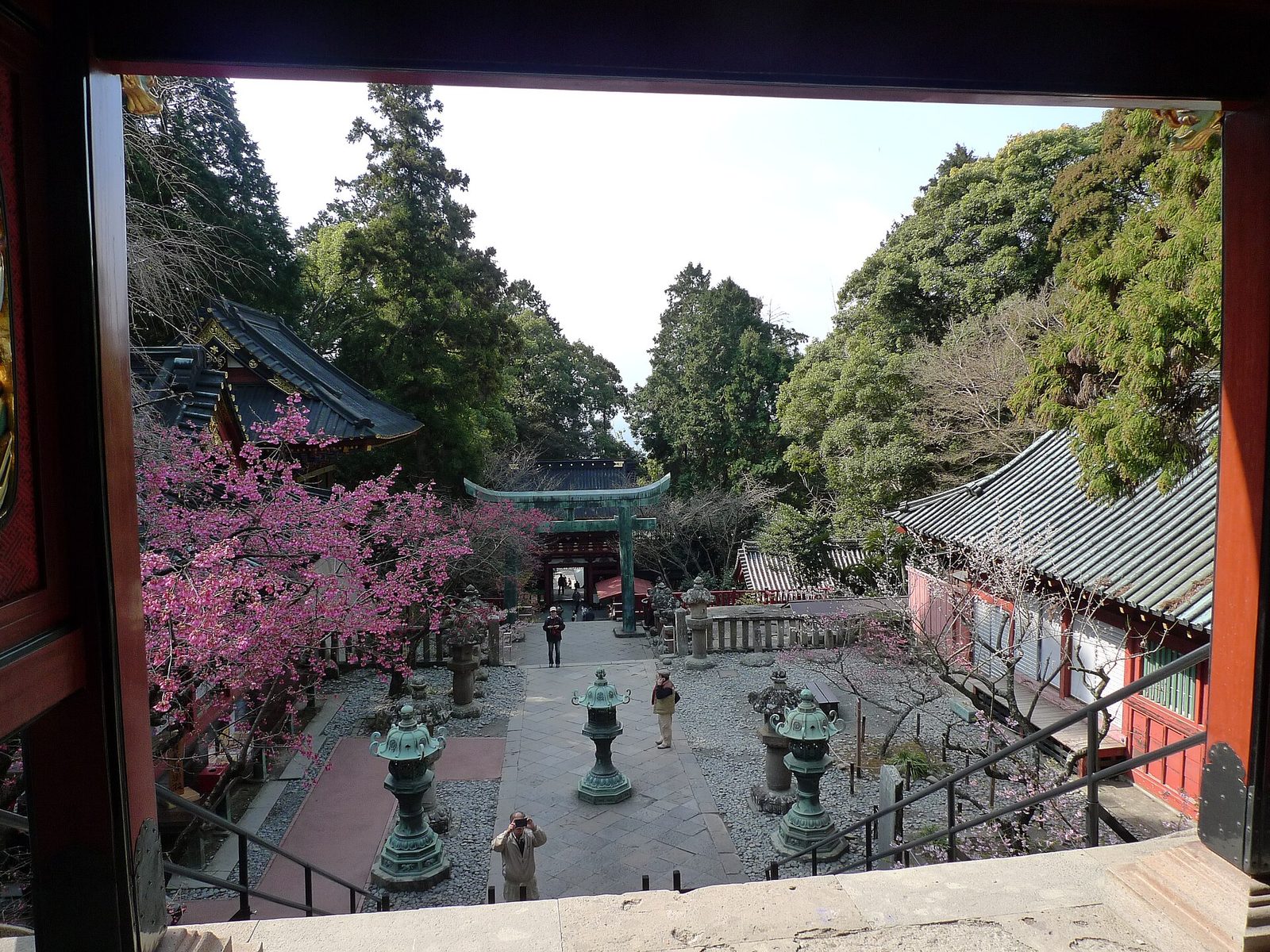
Japan’s oldest Toshogu shrine, dedicated to Tokugawa Ieyasu. The main hall, covered in vividly painted carvings, is designated a National Treasure.
Admission is ¥700 for the shrine, ¥600 for the museum, or ¥1,200 for a combined ticket. If you plan to see the museum — home to artifacts associated with Ieyasu — the combined ticket is well worth it.
The main hall can be viewed from a covered corridor, so rain won’t interfere with your visit. Just take your time on the stone steps and paving, which get slippery when wet.
For details on reaching Nihondaira and Kunozan Toshogu independently, including costs, see our Nihondaira & Kunozan Toshogu Guide.
Nihondaira Ropeway
A ropeway connecting the summit of Nihondaira with Kunozan in about five minutes. It drops dramatically across a ravine, making it a fun ride despite its brevity.
It operates as usual in the rain, but suspends service in strong winds or thunderstorms. If the weather looks rough on the day, check the operating status at the station before committing to your plan.
Toro Ruins & Toro Museum

A Special National Historic Site where rice paddies and a village from the Yayoi period, around 2,000 years ago, were discovered. Pit dwellings, raised-floor storehouses, and paddy fields have been reconstructed, giving you a real sense of the scale of life back then.
The first floor of the museum is free to enter and offers hands-on exhibits about Yayoi life. The second-floor permanent exhibition (¥300 for adults) displays excavated wooden farming tools and more.
The outdoor reconstruction area is hard to walk in the rain, so on this day it makes sense to focus your time on the indoor museum exhibits.
Shimizu Sushi Yokocho (inside S-PULSE DREAM PLAZA)
A cluster of sushi restaurants inside Dream Plaza. Try tuna landed at Shimizu Port and gunkan-maki topped with sakura shrimp.
Prices generally run ¥1,500–4,000. Many restaurants offer English menus and accept cards.
Being just a five-minute walk from the pier, you can sit down without worrying about your all-aboard time.
S-PULSE DREAM PLAZA
A shopping complex right beside the port. Shopping, dining, and resting all in one place make it an ideal way to wrap up a rainy day.
Inside you’ll find “Chibi Maruko-chan Land” (¥1,200 for adults, ¥700 for ages 3 through elementary school, 10:00–20:00). Creator Momoko Sakura was from Shimizu, and the series is set here.
The Ferris wheel “Dream Sky” costs ¥700, stands 52 m tall, and takes about 13 minutes per rotation. It closes in strong winds. For souvenirs, you’ll find wasabi-zuke, Shizuoka tea, and sakura shrimp products all in one place.
Opening Status on Wednesday, October 7, 2026
- Kunozan Toshogu: Open (9:00–17:00, open daily)
- Nihondaira Ropeway: Operating normally (suspended in strong winds or thunderstorms)
- Nihondaira Yume Terrace: Open (9:00–17:00. Closed on the 2nd Tuesday, so open Wednesday)
- Toro Ruins & Toro Museum: Open (museum 9:00–16:30. Closed Mondays and the day after holidays, so open Wednesday)
- S-PULSE DREAM PLAZA: Open (shops 10:00–20:00 / restaurants 11:00–21:00)
- Chibi Maruko-chan Land: Open (10:00–20:00, last entry 19:30, open year-round)
- Verkehr Museum: Open (9:30–16:30. Closed Mondays, so open Wednesday)
- Shimizu Fish Market “Kashi no Ichi”: Closed (Wednesday) — Ichiba-kan and Maguro-kan are closed, with only a few shops as possible exceptions
- Shimizu Port Water Bus: 7 sailings per day (may be cancelled in rough weather)
Kashi no Ichi being closed is a significant difference if you had your heart set on Shimizu tuna. Try Shimizu Sushi Yokocho at Dream Plaza or restaurants around Shimizu Station instead.
If you find yourself with time to spare, the Verkehr Museum along the waterfront (¥400 for adults) is another option. Highlights include ship models, the history of Shimizu Port, and a canned-goods museum — Shimizu is also Japan’s top producer of canned tuna.
For options beyond those covered here — from walkable spots to half-day routes and rainy-day plans — see 20 Things to Do in Shimizu.
5. Events in Shimizu on October 7, 2026
Early October in Shimizu is a pleasant time to be out, with the heat finally easing.
For this particular port call, however, we weren’t able to confirm any specific events. Small community gatherings and limited-time happenings are often announced at the last minute. For same-day information, your best bet is the tourist information desk inside the Shimizu Port Passenger Terminal or the one at Shimizu Station. Searching “清水 イベント” (Shimizu events) online can also turn up same-day listings on local news sites.
⚠️ Events may be changed or cancelled due to weather or other circumstances. Please check official sources before heading out.
6. Local Food Specialties of Shimizu and Shizuoka
The Shimizu and Shizuoka area is one of Japan’s great food destinations. Here are the specialties worth seeking out on your day in port.
| Dish | Where | Price range | Notes |
|---|---|---|---|
| Tuna rice bowl | Kashi no Ichi Maguro-kan (closed Wed., incl. 10/7) | ¥1,000–2,500 | Shimizu Port is famous for tuna landings. For those calling on a non-Wednesday |
| Shimizu sushi | Shimizu Sushi Yokocho, Dream Plaza | ¥1,500–4,000 | 5 minutes on foot from the pier. Many shops have English menus and accept cards |
| Sakura shrimp kakiage | Yui area (25 min by car) and city restaurants | ¥800–1,500 | October is autumn fishing season. Many shops are cash only |
| Shizuoka oden | Aoba Yokocho, central Shizuoka City | ¥500–1,500 | Known for kuro-hanpen and dashi powder. Most shops open from evening |
| Seafood takeout | Kashi no Ichi Ichiba-kan (closed Wed., incl. 10/7) | ¥500–2,000 | Great souvenir items like sakura shrimp shumai |
| Wasabi | Throughout Shimizu and Shizuoka City | ¥300–3,000 | Shizuoka is Japan’s top wasabi producer. Try wasabi-zuke and wasabi soft serve |
The one we especially want to highlight is a taste unique to October: sakura shrimp.
Sakura shrimp are tiny shrimp, only a few centimetres long, commercially fished nowhere in Japan but Suruga Bay. There are two seasons a year — spring (March–June) and autumn (October–December) — and October 7 falls right around the start of the autumn season.
Raw sakura shrimp are a translucent pink, with a faint sweetness that spreads as you eat them. They can only be enjoyed truly fresh, which makes a cruise stop at a Suruga Bay port at this time of year a rare opportunity.
The most popular preparation is kakiage (tempura fritters) — thin batter that lets the shrimp’s aroma come through. Specialty restaurants cluster around Yui Fishing Port where they’re landed, but you can also try them as gunkan-maki at Shimizu Sushi Yokocho or at restaurants in Dream Plaza. Raw sakura shrimp depend on the day’s catch, so ask at the restaurant: “Do you have raw sakura shrimp today?”
For a deeper dive into tuna, sakura shrimp, and shirasu — their seasons, how to eat them, and where to go — see our Shimizu Seafood Guide.
7. Practical Information for a Worry-Free Day
Wi-Fi
- Shimizu Port Terminal: free Wi-Fi available
- S-PULSE DREAM PLAZA: free Wi-Fi available
- Convenience stores (7-Eleven, Lawson, FamilyMart): nationwide free Wi-Fi available
- If you expect to be online a lot, buying a prepaid SIM at the airport when you arrive in Japan makes life easier
Payment
Cash is still the norm at many businesses in Japan, and it’s the safest bet at small restaurants and in taxis.
Credit cards are accepted at larger shops in S-PULSE DREAM PLAZA and Kashi no Ichi. Visa and Mastercard are the main brands accepted; Amex and Diners are sometimes declined.
Near the port, Seven Bank ATMs inside convenience stores accept overseas-issued cards for withdrawals. As a rough guide, carrying ¥3,000–10,000 in cash per person per day should cover you.
IC Transit Cards
Suica, ICOCA, and other nationally interoperable IC cards work on both buses and trains.
You can buy a card at convenience stores near the port or at JR Shimizu Station. Cash works too, but bus change machines only accept coins and ¥1,000 notes, so having small change on hand keeps things smooth.
Language Support
The tourist information desks (Shimizu Port Terminal and Shimizu Station) have English-speaking staff.
At S-PULSE DREAM PLAZA and Kashi no Ichi, you’ll find shops with English menus and English-speaking staff. The “Mihoshirube” facility at Miho no Matsubara stocks multilingual pamphlets.
Taxi drivers generally speak only Japanese. Google Translate’s camera and voice input features work well for conveying destinations and specific requests.
Tourist Information Centers
- Inside Shimizu Port Passenger Terminal: right where you disembark
- Shimizu Station Tourist Information: about 1.5 km from the pier (free shuttle, or 20–25 minutes on foot)
Emergency Contacts
| Purpose | Number |
|---|---|
| Police | 110 |
| Ambulance / Fire | 119 |
| Shizuoka City Tourist Information Center (Shizuoka Station North Exit, English available) | 054-253-1170 |
| Taxi (Shizutetsu Taxi central dispatch) | 054-281-5111 |
8. Returning to the Ship
Star Seeker departs at 17:00. Plan to be back at Hinode Pier by 16:30 at the latest.
Roads get congested in the rain, and taxi travel times become harder to predict. If you’re coming back from the mountain side (Nihondaira or Kunozan), allow yourself even more buffer.
If you’re navigating with Google Maps, search for “Shimizu Port Hinode Pier” or “清水港 日の出埠頭.” It’s about a five-minute walk from S-PULSE DREAM PLAZA.
In a taxi, just tell the driver “Shimizu Port Hinode Pier” (清水港 日の出埠頭) and you’ll be understood. Showing them this page on your screen works too.
9. About Star Seeker
Star Seeker is a small ship of 9,923 gross tons. Where large cruise ships carry thousands of passengers, a vessel of this size welcomes far fewer guests, which gives her an intimate, yacht-like atmosphere.
The benefit of being small shows up in your time ashore. Disembarkation lines are short, so you’re out in town soon after arrival — and on a nine-hour port call like this one, that difference translates directly into sightseeing time.
Ships of this size typically offer dining and leisure facilities scaled to a smaller number of guests, along with a relaxed, informal onboard atmosphere — the kind of experience that only works when the passenger count stays low.
After the bustle of Tokyo, Shimizu offers a shift into quieter layers of time — a shrine atop a mountain and a village from 2,000 years ago. It may be a rainy day, but with so much of it spent under a roof, you should be able to linger over each place at your own pace.
From Shimizu, Star Seeker heads for Shingu, the gateway to Kumano. From Suruga Bay the journey continues west, toward Japan’s ancient pilgrimage paths.
良い旅を。Have a wonderful voyage.