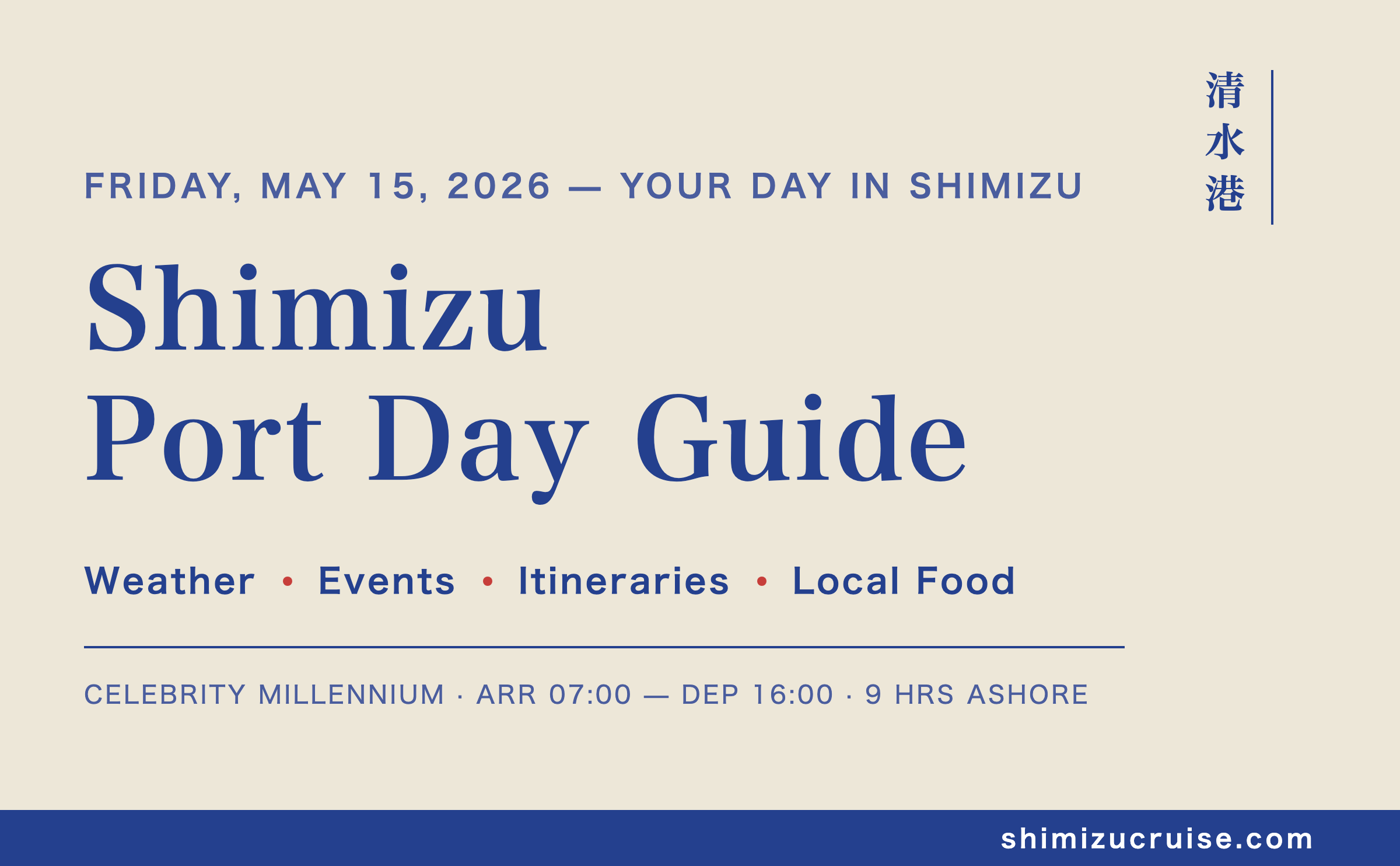
Friday, May 15, 2026. Celebrity Millennium departs Tokyo and sails southwest across the Pacific overnight, arriving at Shimizu Port’s Hinode Pier at 07:00. Departure is set for 16:00 the same day, bound for Osaka. Docking with Mount Fuji rising directly ahead in the crisp morning air of Suruga Bay is a sight that stays with you — one of the most memorable moments unique to this itinerary.

🇯🇵 日本語版はこちら: 日本語で読む
While the scheduled port time is nine hours, accounting for disembarkation and re-boarding procedures, you can realistically expect around 7 to 7.5 hours of time ashore. Even so, that’s plenty of time to take in everything Shimizu and Shizuoka have to offer: a panoramic observatory with sweeping 360-degree views of snow-capped Mount Fuji, Japan’s oldest Toshogu shrine with its brilliantly colored National Treasure buildings, the UNESCO World Cultural Heritage pine grove of Miho no Matsubara where forest meets sea, a fresh tuna bowl straight from Shimizu’s renowned fishing port, and souvenir shopping in the hometown of beloved anime character Chibi Maruko-chan.
This page is your day-by-day guide to making the most of the May 15, 2026 port call. Still carrying the energy of Tokyo, here’s what to see, what to eat, and how to spend your day in Shimizu — from a local perspective.
About the Author
Shimizu Port Cruise Guide — Site Operator
Based in Shizuoka City. I plan and run the “Shimizu Cruise Festival“, an event at Shimizu Port where visitors from Japan and abroad mingle with the local community, and I work on other projects that connect cruise travelers with local people.
Through my interactions with cruise travelers and local residents, I’ve come to realize that enjoying a limited port call is not just about deciding where to go. What really matters is concrete, up-to-date information: How long does it take to get there? Can I visit without a reservation? Will it be open that day?
On this site, I introduce access routes from Shimizu Port, sightseeing spots, events, restaurants, and model itineraries in an easy-to-follow way, from the perspective of someone active on the ground.
My goal is to bring you the kind of real, local information about Shimizu and Shizuoka that guidebooks alone can’t offer, and to help make your day in port an even more enjoyable and memorable one.
- 1. Port Day Basics
- 2. Weather and What to Wear on May 15, 2026
- 3. Moving Around from Shimizu Port
- 4. Recommended Itinerary: "Shizuoka Full Course in Fresh Green Season (Nihondaira, Toshogu, Miho & Food)"
- 5. Local Events on May 15, 2026
- 6. Must-Try Food in Shimizu and Shizuoka
- 7. Practical Tips for a Smooth Day Ashore
- 8. Getting Back to the Ship
- 9. About Celebrity Millennium
- More Celebrity Millennium Calls at Shimizu Port
1. Port Day Basics
Here’s a quick overview of the key details for the May 15, 2026 port call.
| Item | Details |
|---|---|
| Port Date | Friday, May 15, 2026 |
| Arrival | 07:00 |
| Departure | 16:00 |
| Scheduled Time in Port | Approx. 9 hours |
| Realistic Sightseeing Time | Approx. 7–7.5 hours |
| Berth | Shimizu Port, Hinode Pier |
| Previous Port | Tokyo |
| Next Port | Osaka |
May 15 falls right in the heart of Shizuoka’s most pleasant season. The Golden Week crowds have cleared, and before the rainy season arrives (typically in early June), this stretch of clear, comfortable May weather is something locals often call their favorite time of year. Vivid fresh greenery, a still snow-dusted Mount Fuji against a bright blue sky — it’s genuinely one of the best times to visit Shimizu.
May also coincides with the peak harvest of *shincha* (first-flush green tea), one of Shizuoka’s most celebrated local products. Port shops and souvenir stores are well stocked with limited-edition new-harvest tea products during this period. The spring cherry shrimp (*sakura ebi*) fishing season (March through June) is also in full swing, and restaurants around Yui and Shimizu are serving this delicate local specialty at its freshest. If you’re continuing straight from Tokyo, Shimizu offers a wonderful seasonal contrast — a chance to experience Shizuoka at its most vibrant.
2. Weather and What to Wear on May 15, 2026
In May, Shimizu typically sees daytime highs of around 18–23°C (64–73°F) and overnight lows of around 13–17°C (55–63°F). Midday is comfortably warm — often short-sleeve weather — but the early morning arrival at 07:00 can still feel a little cool. The sun grows stronger this time of year, so UV protection is worth thinking about, especially at outdoor spots like Miho no Matsubara and Nihondaira.
For clothing, light tops or shirts will serve you well during the day, but we’d recommend packing a thin jacket or cardigan for the morning disembarkation and late-afternoon return to the ship. Comfortable walking shoes or sneakers are essential — you’ll be doing a fair amount of walking at Nihondaira and Miho no Matsubara, so leave the heels behind. Sunscreen, a hat, and sunglasses are all good ideas. Rain is unlikely, but a compact folding umbrella tucked into your bag is always reassuring.
Please Note: This article was written a few days before the port call, when precise day-of forecasts aren’t yet available. Accurate short-range forecasts typically become available about three days out, so be sure to check for the latest update before you head ashore. On the morning of the port call, searching “Shimizu, Shizuoka weather” will bring up an English-language forecast quickly.
3. Moving Around from Shimizu Port
Here we go through each transport option from three angles: fare structure, payment, and frequency. With a 16:00 departure and 9 hours in port, planning around a taxi is our suggestion for keeping the day fully in your hands.
🚕 Taxi (the most flexible option, and our top pick)

Its greatest asset is covering hard-to-reach places like Nihondaira and Kunozan Toshogu Shrine in one continuous trip. Split among a group, the per-person cost is lighter than you’d imagine.
- 【Where to board】Taxis wait at Hinode Wharf when cruise ships arrive. If you don’t see one, the tourist information desk inside the port terminal can call one for you (Shizutetsu Taxi dispatch center: 054-281-5111)
- 【How fares work】Metered. The initial fare is ¥700 for the first 1.17 km, then ¥100 is added for every 285 m. The meter also runs on time at signals and in traffic. It’s fine to ask for an approximate fare before boarding
- 【Charter option】A time-based charter is ¥7,700 per hour for a standard car. The sightseeing taxi plan (Shizutetsu Taxi) starts at ¥30,800 for 4 hours, about ¥7,700 per person when four ride together. It’s a fitting length for this article’s model route, the fresh-green full Shizuoka course of Nihondaira, Toshogu, Miho, and local food. Work the route out with your driver
- 【Payment】Cash and credit cards are the dependable pair. Transit IC and QR payments vary by vehicle, so confirm before riding if you plan to use them. No tipping
- 【Language】Nearly all drivers speak only Japanese, but showing the spot names from this article (Japanese included) on your phone is more than enough
🚌 Free Shuttle Bus (links the port and Shimizu Station; a surprisingly little-known ally)

Shimizu Port has two different free buses, and they leave from different places.
1. The S-Pulse Dream Plaza free shuttle (year-round, open to everyone)

It links Dream Plaza, Shizutetsu Shin-Shimizu Station and the Minato exit of JR Shimizu Station in about 8 minutes. It leaves from the Dream Plaza bus stop next to the pier, not from Hinode Wharf itself.
- Fare: free. You don’t need to be a shopper to ride
- Frequency: every 30 minutes on weekdays (departing Dream Plaza on the hour and half hour), every 15 minutes on weekends and holidays
- First and last: first bus from Dream Plaza at 10:00, last at 22:20; first from JR Shimizu Station at 9:45
- It does not run before 10:00. On an early arrival, take a taxi or walk for your first move of the day
2. A port-day shuttle for cruise passengers (arranged by the cruise line)

On call days a free bus often leaves from directly in front of Hinode Wharf for Shin-Shimizu and JR Shimizu stations. Unlike the Dream Plaza shuttle, you board it steps from the gangway. During the Celebrity Millennium call on August 16, 2026, it was operated by Ihara Kanko (verified on site by our editors). Whether it runs, and its times and destinations, vary by call — check your ship’s daily program or ask the staff on the pier.
⛴ Water Bus (cross the harbor with Mt. Fuji in view)

Small boats shuttle from the Hinode pier (in front of Dream Plaza) to the Miho area and to Ejiri (the Kashi-no-Ichi fish market side). The voyage itself is a taste of the harbor.
- 【How fares work】A flat rate per section: adults ¥1,000, elementary school children ¥500. Hinode to Miho is about 15 minutes; Hinode to Ejiri about 10 minutes
- 【Frequency】7 sailings a day. No reservations; boarding is first come, first served
- 【How to buy tickets】Buy tickets at the pier
- 【About cancellations】As the route stays within the harbor, cancellations are rare, though typhoons and similar weather can suspend service. Confirm the day’s operations at the pier or by phone (054-353-2222)
🚏 Local Bus (the standard route to Miho: Shizutetsu Justline)
For Miho no Matsubara by public transit, ride the Miho Yamanote Line: ¥440 and about 25 minutes from Shimizu Ekimae to Miho Matsubara Iriguchi. In the fresh-green season, the scenery along the way is a quiet bonus.
- 【Frequency】Broadly 3 to 4 buses per hour during the day
- 【How to ride】Board through the rear door and pay at the front fare box when alighting. Nationwide transit IC cards such as Suica and ICOCA only need a tap when you board and again when you get off
- 【Paying in cash】The onboard change machine handles coins and ¥1,000 bills only. If you’re holding larger notes, break them at a convenience store before boarding
- 【Note】Between the port and the Shimizu Ekimae bus terminal, the free shuttle bus or walking is required
🚃 Train (to central Shizuoka)
The option when you’re headed for the Shizuoka Station area, with the oden alley Aoba Yokocho and Sunpu Castle Park.
- 【JR Tokaido Line】Shimizu to Shizuoka: ¥240, about 12 minutes. Trains run 3 to 4 times per hour in the daytime
- 【Shizutetsu Line】Shin-Shimizu to Shin-Shizuoka: ¥350, about 23 minutes. With service roughly every 8 minutes, the timetable is optional
- 【Payment】Both accept transit IC cards like Suica and ICOCA. Contactless credit card boarding is not supported, so use an IC card or buy a ticket with cash
- 【From the port to the stations】The free shuttle bus is the convenient way to Shimizu and Shin-Shimizu stations
🚶 On Foot (fine for the area right around the port)
- S-Pulse Dream Plaza: right next to the wharf (1 to 3 minutes on foot)
- Shimizu Fish Market “Kashi-no-Ichi”: about 1.3 km, a 15-to-20-minute walk. Or take the water bus from Hinode to Ejiri (about 10 minutes) and step off right in front of the market
- JR Shimizu Station: about 1.5 km, a 20-to-25-minute walk; the free shuttle bus is recommended
- Shizutetsu Shin-Shimizu Station: about 1 km, around 15 minutes on foot

4. Recommended Itinerary: “Shizuoka Full Course in Fresh Green Season (Nihondaira, Toshogu, Miho & Food)”
“We’ve got nearly nine hours — but where do we even begin?” With a generous port window running from 07:00 to 16:00, you have a real opportunity to do it all. This “Shizuoka Full Course” itinerary takes in Shimizu’s three unmissable highlights — Nihondaira, Kunozan Toshogu, and Miho no Matsubara — with a seafood lunch and souvenir shopping thrown in for good measure.
On a clear May day, Nihondaira is something else entirely. A 360-degree panorama of snow-capped Mount Fuji and sparkling Suruga Bay, framed by fresh green foliage — it’s the kind of view you’ll be telling people about for years. From there, a ropeway carries you down to Kunozan Toshogu, one of Japan’s most historically significant shrines. Then it’s on to the UNESCO-listed Miho no Matsubara for that iconic view of Fuji through the pine trees, a seafood lunch to recharge, and a final stop for Chibi Maruko-chan souvenirs before heading back to the ship. This route gives you the full Shimizu experience in a single day.
Sample Schedule
| Time | Location | Activity | Duration |
|---|---|---|---|
| 07:00 | Shimizu Port, Hinode Pier | Ship arrives; disembarkation begins | — |
| 07:30 | Hinode Pier | Disembark; arrange taxi at tourist info center | 30 min |
| 08:00 | Depart | Taxi to Nihondaira (approx. 20–30 min) | Transit |
| 08:30 | Nihondaira / Yume Terrasse | 360° views of Fuji, Suruga Bay & Southern Alps | 60 min |
| 09:30 | Nihondaira | Board Nihondaira Ropeway (approx. 5 min) | Transit |
| 09:40 | Kunozan Toshogu | Explore the National Treasure shrine & museum | 90 min |
| 11:10 | Kunozan | Ropeway back to Nihondaira; rejoin taxi | Transit |
| 11:30 | Kashi no Ichi (Maguro-kan) | Tuna bowl lunch (approx. 20 min by taxi) | 60 min |
| 12:30 | Kashi no Ichi | Depart by taxi toward Miho no Matsubara | Transit |
| 12:45 | Miho no Matsubara | Walk the “God’s Path” & see the Hagoromo Pine; Fuji views through the pines (approx. 20 min by taxi) | 90 min |
| 14:15 | Miho no Matsubara | Water bus or taxi back toward Shimizu Port (approx. 30–40 min) | Transit |
| 14:50 | S-Pulse Dream Plaza | Chibi Maruko-chan Land & souvenir shopping | 40 min |
| 15:30 | Hinode Pier | Return for re-boarding (allow plenty of time) | — |
| 16:00 | Shimizu Port | Ship departs | — |
Estimated budget: approx. ¥10,000–¥14,000+ per person (including taxi charter, ropeway, admission fees, lunch & souvenirs)
Nihondaira / Nihondaira Yume Terrasse
Perched at 307 meters above sea level, the Nihondaira Yume Terrasse offers a full 360-degree observation deck with views that encompass Mount Fuji, Suruga Bay, the Southern Alps, and Miho no Matsubara — all at once. The building itself is worth a look: it was designed by celebrated architect Kengo Kuma. In May, the contrast between the vivid new-green foliage and the lingering snow on Fuji is especially photogenic. The outdoor observation walkway is well-maintained and easy to navigate in comfortable shoes.
Kunozan Toshogu
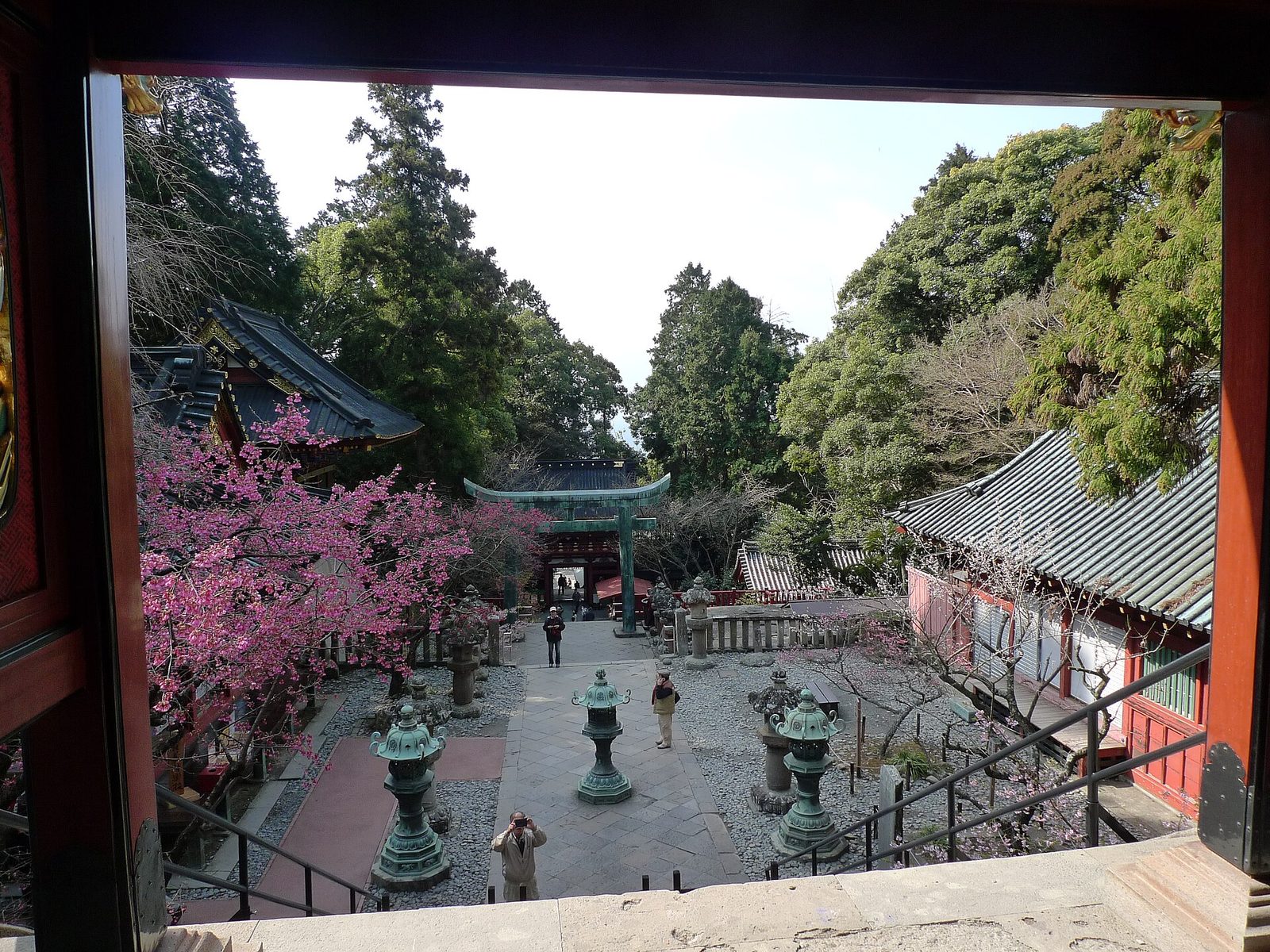
This is the oldest Toshogu shrine in Japan, enshrining Tokugawa Ieyasu — the founder of the Tokugawa shogunate. Built in 1617, the brilliantly colored shrine buildings are designated National Treasures of Japan, their intricate carvings and gold leaf breathtaking up close. The ropeway ride from Nihondaira adds its own charm — a five-minute aerial crossing with views over the hillside. The onsite museum displays personal artifacts and historical materials connected to Ieyasu, making this a particularly compelling stop for anyone interested in Japanese samurai history.
Shimizu Fish Market “Kashi no Ichi” (Maguro-kan)

Kashi no Ichi is a public fish market facility built around Shimizu Port’s fresh catch, with the Maguro-kan (Tuna Hall) housing several restaurants serving up generous tuna bowls and sashimi platters at honest prices. Shimizu is one of Japan’s top tuna landing ports, and the freshness here is genuinely exceptional. Some restaurants have English menus, so international visitors can order with confidence.
Miho no Matsubara
A stretch of some 30,000 pine trees curving around a peninsula on Suruga Bay, with Mount Fuji rising behind them — this is one of the component sites of the UNESCO World Cultural Heritage inscription for “Fujisan.” The “Michiwa no Michi” (God’s Path), a quiet pine-needle-carpeted lane through the forest, has been considered sacred since ancient times and is deeply atmospheric to walk. The Hagoromo Pine (*Hagoromo no Matsu*) is a legendary tree appearing in classical Japanese literature, said to be where a celestial maiden hung her feathered robe.
S-Pulse Dream Plaza
Right next to the port, S-Pulse Dream Plaza is the ideal last stop before returning to the ship. “Chibi Maruko-chan Land” — a museum-style attraction dedicated to the beloved anime series set in Shimizu — is fun for all ages (separate admission required). The complex also has a wide range of Shizuoka-themed souvenirs, including local tea, wasabi, and tuna products.
Operating Status on Friday, May 15, 2026
- ✅ Nihondaira Yume Terrasse — Open as usual on Fridays (closed the 2nd Tuesday of each month, so no issue)
- ✅ Kunozan Toshogu — No regular closing day; open as usual (9:00–17:00)
- ✅ Nihondaira Ropeway — No regular closing day; running as usual (9:00–17:00)
- ⚠️ Kashi no Ichi (Maguro-kan) — Closed Wednesdays, so open on Fridays. Individual restaurant hours vary; aim to visit between 11:00 and 13:00 for the best selection
- ✅ Miho no Matsubara (God’s Path & Hagoromo Pine) — Open at all times; free admission
- ✅ Miho no Matsubara Visitor Center “Mihoshiruwe” — 9:00–16:30 (no regular closing day)
- ✅ S-Pulse Dream Plaza — Open as usual on Fridays (shops: 10:00–20:00)
- ⚠️ Water Bus (Miho Hagoromo Line) — Weekday schedules after Golden Week should be confirmed in advance. Given the 16:00 departure, there is very little margin with the last boat from Miho (arriving Hinode at approximately 15:55), so we strongly recommend taking a taxi on the return leg
May Note: May 15 falls after the Golden Week holiday rush (late April to early May), meaning the main sightseeing spots will be noticeably less crowded and much more relaxed to visit. All major attractions are operating normally, and wait times are generally short — a real sweet spot for visiting.
5. Local Events on May 15, 2026
Friday, May 15 brings a gentle early-summer breeze to the Shimizu and Shizuoka area. After Golden Week, the region settles into a quieter rhythm, with various cultural and arts events taking place across the city. These offer a different side of local life — worth a brief detour if your schedule allows.
1. FY2026 Archaeological Techniques Experience
| Item | Details |
|---|---|
| Event Name | FY2026 Archaeological Techniques Experience |
| Dates | May 2026 (see official website for details) |
| Venue | Shizuoka City (see official website for details) |
Shizuoka is home to the Toro Ruins, one of Japan’s most significant Yayoi-period archaeological sites. This hands-on program lets participants try out real archaeological techniques — a special, off-the-beaten-path experience for history enthusiasts and a fun activity for families with children.
2. Kikuzo Mochizuki: Hamoji-bun and Illustration Exhibition
| Item | Details |
|---|---|
| Event Name | Kikuzo Mochizuki: Hamoji-bun and Illustration Exhibition |
| Dates | May 2026 (see official website for details) |
| Venue | Shizuoka City (see official website for details) |
This exhibition showcases a uniquely Japanese art form called *hamoji* — a technique in which characters and illustrations are woven together into a single expressive work. Even without knowledge of Japanese, the pieces are visually captivating and offer a fascinating window into Japan’s rich tradition of written artistry.
3. Shimizu Oyako Theatre: “55 Years of History” Poster Exhibition, Volume 3
| Item | Details |
|---|---|
| Event Name | Shimizu Oyako Theatre: “55 Years of History” Poster Exhibition, Vol. 3 |
| Dates | May 2026 (see official website for details) |
| Venue | Shimizu (see official website for details) |
For over 55 years, Shimizu Oyako Theatre has been bringing the performing arts to children in this community. This poster retrospective traces that history, offering a glimpse into a quieter, community-centered side of Shimizu that most visitors never see — the port town’s cultural soul.
4. Canvas 10 Watercolor Exhibition
| Item | Details |
|---|---|
| Event Name | Canvas 10 Watercolor Exhibition |
| Dates | May 2026 (see official website for details) |
| Venue | Shizuoka City (see official website for details) |
A group show by a local watercolor painting circle. Works often feature Shizuoka’s iconic landscapes — Mount Fuji, Suruga Bay, and the surrounding hills — offering a chance to rediscover the area’s natural beauty through an artist’s eye. Admission is typically free, making it an easy drop-in between sightseeing stops.
6. Must-Try Food in Shimizu and Shizuoka
The Shimizu and Shizuoka area is one of Japan’s standout food destinations. Here are the dishes and flavors you won’t want to miss on your port day.
| Dish | Where to Find It | Price Range | Notes |
|---|---|---|---|
| Tuna bowl / Tuna sashimi platter | Kashi no Ichi – Maguro-kan (15 min walk) | ¥1,000–2,500 | Fresh hon-maguro direct from Shimizu Port. English menus available |
| Shimizu sushi | Shimizu Sushi Yokocho (inside Dream Plaza, 5 min walk) | ¥1,500–4,000 | Tuna and sakura ebi gunkan are exceptional. Card payments accepted |
| Sakura ebi kakiage (cherry shrimp tempura fritter) | Yui Fishing Port area (25 min by car) | ¥800–1,500 | Spring fishing season at its peak in May. Fresh raw sakura ebi also available |
| Shizuoka oden | Aoba Yokocho (5 min walk from Shizuoka Station) | ¥500–1,500 | The local way: black hanpen fish cake topped with green seaweed powder |
| Seafood bowl / Minced tuna | Kashi no Ichi – Ichiba-kan (15 min walk) | ¥500–2,000 | Renovated in 2025. Takeaway options also available |
| Wasabi dishes & wasabi soft serve | Various spots near the port | ¥300–3,000 | Shizuoka is Japan’s top wasabi-producing region. Great for souvenirs too |
| New-harvest tea sweets & deep-steamed green tea | Dream Plaza & around Shimizu Station | ¥300–1,000 | First-flush tea harvest at its peak in May — a seasonal flavor you can only get now |
One flavor above all deserves a special mention in May: sakura ebi (cherry shrimp). These tiny, jewel-pink shrimp are found only in Suruga Bay — the world’s sole fishing ground for this species — and the spring fishing season runs from March through June, with May at the very peak. Sweet, aromatic, and delicate in flavor, they’re transformed into something wonderfully fragrant when made into *kakiage* (tempura fritters). During this season, restaurants in the Yui area also serve them raw as sashimi, or piled fresh onto a rice bowl. If you’re arranging a taxi charter that takes you toward Yui, ask your driver for a local restaurant recommendation — they’ll know exactly where to go.
7. Practical Tips for a Smooth Day Ashore
Wi-Fi
Free Wi-Fi is available inside the Shimizu Port Passenger Terminal from the moment you disembark. S-Pulse Dream Plaza also offers free in-building Wi-Fi. Major convenience store chains — 7-Eleven, Lawson, and FamilyMart — provide free Wi-Fi through services like 7Spot and LAWSON Free Wi-Fi. If you expect to use significant mobile data, we strongly recommend picking up a prepaid SIM card at the airport when you arrive in Japan.
Payment
Cash is still king at many Japanese establishments, particularly smaller restaurants, street stalls, and taxis — which are often cash only. Larger retailers at S-Pulse Dream Plaza and Kashi no Ichi generally accept credit cards; Visa and Mastercard are widely accepted, though American Express and Diners Club may not be accepted everywhere. There is a 7-Eleven with a Seven Bank ATM near the port, where you can withdraw Japanese yen using overseas debit or credit cards. We’d recommend having at least ¥5,000–¥10,000 in cash per person ready to go from the start of the day.
IC Transit Cards (Suica / ICOCA)
Suica and ICOCA (and other compatible IC cards) can be used on JR lines and local buses in the Shimizu area. You can purchase or top up a card at nearby convenience stores or at JR Shimizu Station’s ticket machines and counter. Cash is accepted on buses and trains, but note that buses may not give change, so having coins on hand is useful. An IC card makes boarding faster and more convenient.
Language Support
English-speaking staff are available at the tourist information centers inside the Shimizu Port Passenger Terminal and at Shimizu Station. S-Pulse Dream Plaza and Kashi no Ichi both provide English menus and information brochures. The Miho no Matsubara Visitor Center “Mihoshiruwe” offers multilingual pamphlets. While most taxi drivers speak Japanese only, the real-time translation feature in Google Translate works remarkably well for in-car communication — we recommend downloading it in advance.
Tourist Information Centers
- Shimizu Port Passenger Terminal Tourist Information Center — Located inside the terminal building, just steps from the gangway. Best for arranging taxis, picking up maps, and grabbing English-language brochures
- Shimizu Station Tourist Information Center — About 15 minutes on foot from the port. Good for bus route information and broader regional guides
Emergency Contacts
| Purpose | Number |
|---|---|
| Police | 110 |
| Ambulance / Fire | 119 |
| Shizuoka City Tourism (English) | 054-221-1173 |
| Taxi (Shizutetsu Taxi) | 054-285-1212 |
8. Getting Back to the Ship
The ship departs at 16:00. Please plan to be back at Shimizu Port’s Hinode Pier no later than 15:30 — at least 30 minutes before departure. Re-boarding can take some time, so a comfortable buffer is always wise.
Your berth is Shimizu Port, Hinode Pier. Searching “Shimizu Port Hinode Pier” or “清水港 日の出埠頭” on Google Maps will show you directions from wherever you are.
A taxi is the most reliable way to get back from any point in the city. Simply tell the driver “Hinode Pier” — or show them the map on your phone to be absolutely sure. Most drivers will recognize it immediately.
If you’re coming back from Miho no Matsubara in particular, keep a close eye on the time — it can get tight. We’d suggest wrapping up at Miho no Matsubara by 14:15 at the latest and taking a taxi directly back to Hinode Pier (approximately 20–30 minutes).
9. About Celebrity Millennium
Celebrity Millennium is the flagship of Celebrity Cruises’ Millennium Class, a large ocean liner of 91,011 gross tons. Launched in 2000, the ship underwent a major refurbishment in 2019 — known as the “Millennium Refresh” — that incorporated design elements from the newer Edge Class, giving the interiors a fresh, contemporary feel. On Asian itineraries, the ship is well regarded for its refined atmosphere and attentive service, and it’s a popular choice for Japan coastal cruises like this Tokyo-to-Osaka voyage.
One of the ship’s highlights is its dining scene. Alongside the main dining room, the Marchan Restaurant, several specialty restaurants offer more intimate culinary experiences, sometimes incorporating ingredients inspired by the ports of call. For entertainment, the ship doesn’t hold back: a casino, theater, spa, pool, rooftop Jacuzzis, and more — everything you’d expect from a top-tier resort hotel, ready and waiting after a day of sightseeing. And as Celebrity Millennium leaves Shimizu and heads toward Osaka and Kobe, stepping out on deck to watch the silhouette of Mount Fuji slowly receding across Suruga Bay at dusk may well be the most quietly unforgettable moment of the entire voyage.
From the vibrant energy of Tokyo to the fresh sea breeze of Suruga Bay — we hope your day in Shimizu becomes one of the most cherished chapters of this journey. Wonderful experiences await in Osaka too, but for now, take in today’s memories alongside the view of Fuji, and carry them with you.
良い旅を。Have a wonderful voyage.
More Celebrity Millennium Calls at Shimizu Port
Guides for this ship’s other port calls:
- Port Call Guide: April 20, 2026
- Port Call Guide: April 22, 2026
- Port Call Guide: May 13, 2026
- Port Call Guide: June 5, 2026
- Port Call Guide: June 17, 2026
- Port Call Guide: July 11, 2026
- Port Call Guide: July 14, 2026
- Port Call Guide: July 26, 2026
- Port Call Guide: August 16, 2026
- Port Call Guide: August 29, 2026
- Port Call Guide: September 9, 2026
- Port Call Guide: October 15, 2026
- Port Call Guide: October 28, 2026