Nihondaira is a 307-meter plateau with Shizuoka’s finest Mount Fuji view; Kunozan Toshogu is the original Tokugawa shrine below it. A five-minute ropeway connects the two, and together they make one of the easiest trips in Japan to do on your own: a 20 to 30 minute taxi ride from Shimizu port, a spectacular ropeway crossing, and entrance fees that total less than ¥2,000 per person. Every cruise line calling here sells the same pairing as a shore excursion from around $149 per person. This guide covers how to do it independently, what it costs, and what you’ll see.
🇯🇵 日本語版はこちら: 日本語で読む
Why This Trip Is Worth Your Shore Day
Shimizu has three signature destinations: the seafood of the port itself, the UNESCO-listed pine grove at Miho no Matsubara, and the Nihondaira–Kunozan pairing in the hills south of the city. The third is the one most passengers only ever see through a tour bus window — which is a shame, because it combines two very different experiences in one compact trip:
Nihondaira is a 307-meter plateau with what many consider the finest publicly accessible panorama in Shizuoka: Mt. Fuji rising over Suruga Bay, the Southern Japan Alps on the horizon, the tea fields below, and the Miho peninsula curling into the sea. Local legend traces the name to Yamato Takeru, the mythical prince said to have surveyed the region from this summit.
Kunozan Toshogu is the original Tokugawa shrine — older than the famous one in Nikko. When Tokugawa Ieyasu, the shogun who unified Japan after a century of civil war, died in 1616 at nearby Sunpu Castle, his will directed that he be buried on Mt. Kuno. His son, the second shogun Hidetada, completed the shrine in 1617. The lavishly carved and gilded main sanctuary was designated a National Treasure in 2010. Whether Ieyasu’s remains later moved to Nikko or still rest here is a debate historians (and the two shrines) politely continue to this day.
The two sites are connected by a ropeway that glides across a forested ravine in about 5 minutes — the journey itself is one of the highlights.
Getting There from Shimizu Port
There is no direct public transport from the cruise pier to Nihondaira, which is exactly why the DIY option is under-used. Your realistic choices:
Option 1: Taxi (recommended)


A taxi from Hinode Pier to the Nihondaira summit takes about 20 to 30 minutes. Expect a metered fare of a few thousand yen each way (traffic dependent) — split among 3 or 4 passengers, it is far cheaper than a ship excursion. Show the driver this: 「日本平ロープウェイまでお願いします」 (To the Nihondaira Ropeway, please).
Two practical tips:
- Consider a charter. Drivers at the port offer 4-hour charters for roughly ¥15,000–20,000 per car. For this itinerary — port → Nihondaira → wait during your shrine visit → back to port — a charter removes the one real risk of the DIY approach: finding a taxi for the return leg. The tourist information desk at the pier can help arrange one.
- Ask the driver to wait or return. Taxis do not reliably wait at the summit. If you don’t charter, agree on a pickup time before the driver leaves, or ask ropeway staff to call a taxi for your return.
Option 2: Bus via Shizuoka Station (for longer port calls)
If your ship is in port 8 hours or more and you enjoy local transport, take the JR Tokaido Line from Shimizu Station to Shizuoka Station (about 10 minutes), then the Shizutetsu Justline Nihondaira Line bus from stop 11 in front of the station directly to the ropeway (about 45–50 minutes, departures roughly every 30 minutes during the day). Note that these buses are cashless — IC cards (Suica/PASMO) and contactless credit cards work; cash does not.
Option 3: The 1,159 Stone Steps (for the energetic)
Kunozan Toshogu can also be reached from the coastal side, climbing the famous 1,159 stone steps from Kunozan-shita at the foot of the mountain — a zigzagging 30–40 minute ascent with ocean views and, in season, the scent of the strawberry greenhouses that line the coast below. Locals remember the number with the pun *ichi-ichi-go-kuro-san* (“thanks for all the trouble, one step at a time”). Doing the steps up and the ropeway down (or vice versa) is a genuinely great combination if you have the legs and the time.
Suggested Half-Day Itinerary (About 4 Hours)
This assumes a morning arrival — mornings also give you the best odds of a clear Mt. Fuji.
| Time | Activity | Notes |
|---|---|---|
| 09:00 | Taxi from Hinode Pier | 20–30 min |
| 09:30 | Nihondaira Yume Terrace | Free observation facility; 360° views |
| 10:15 | Ropeway to Kunozan Toshogu | ¥1,250 round trip, 5 min each way |
| 10:30 | Kunozan Toshogu Shrine & Museum | ¥700 shrine / ¥1,200 combo ticket |
| 11:45 | Ropeway back to Nihondaira | Last leg of the loop |
| 12:00 | Taxi back toward the port | Ask driver to drop you at Kashi-no-ichi fish market for lunch |
| 12:30 | Tuna lunch near the port | See our Shimizu Seafood Guide |
Total cost per person (shared taxi, shrine + museum combo): roughly ¥3,500–5,000 — a fraction of the excursion price, on your own schedule.
Nihondaira Yume Terrace: The Free Highlight
Opened in 2018, the Yume Terrace (“Dream Terrace”) is a striking wooden observation facility designed by the studio of architect Kengo Kuma, its latticed roof inspired by traditional Japanese joinery. Admission is free.
- Hours: 9:00–17:00 (Saturdays until 21:00). Closed the 2nd Tuesday of each month and December 26–31.
- The outdoor viewing corridor is open around the clock, so even on a closure day the panorama itself is never off-limits.
- Inside you’ll find exhibits on the region’s geology and history, and a café on the upper floor — a cup of Shizuoka green tea with Mt. Fuji filling the window is the kind of moment cruise memories are made of.
Will you see Mt. Fuji? Be honest with your expectations: the mountain makes its own weather. Your best odds are early morning, and clear-air months (late autumn through early spring) are dramatically better than humid midsummer. Even when Fuji hides, the sweep of Suruga Bay, the tea slopes, and your own ship at the pier far below make the trip worthwhile.
The Ropeway: 5 Minutes Over the Ravine
The Nihondaira Ropeway connects the plateau to the shrine, crossing a steep wooded gorge with Suruga Bay glittering beyond.
| Item | Details |
|---|---|
| Fare | Adults ¥1,250 round trip (¥630 children) |
| Ride time | About 5 minutes each way |
| Frequency | Every 10–15 minutes (more often when busy) |
| Operating hours | First car from Nihondaira 9:10; last car back from Kunozan 17:00 |
Important for 2026 visitors: the operator has announced temporary suspensions for facility renewal works during the 2026 season. Check the official Shizutetsu ropeway operating calendar (or ask at the port tourist information desk) before you commit to the trip — if the ropeway is closed on your date, the shrine is still reachable via the 1,159 steps or by taxi to the base at Kunozan-shita.
There is also a discounted ropeway + shrine set ticket sold at the ropeway station — ask at the counter, as it usually beats buying separately.
Kunozan Toshogu: The Original Tokugawa Shrine
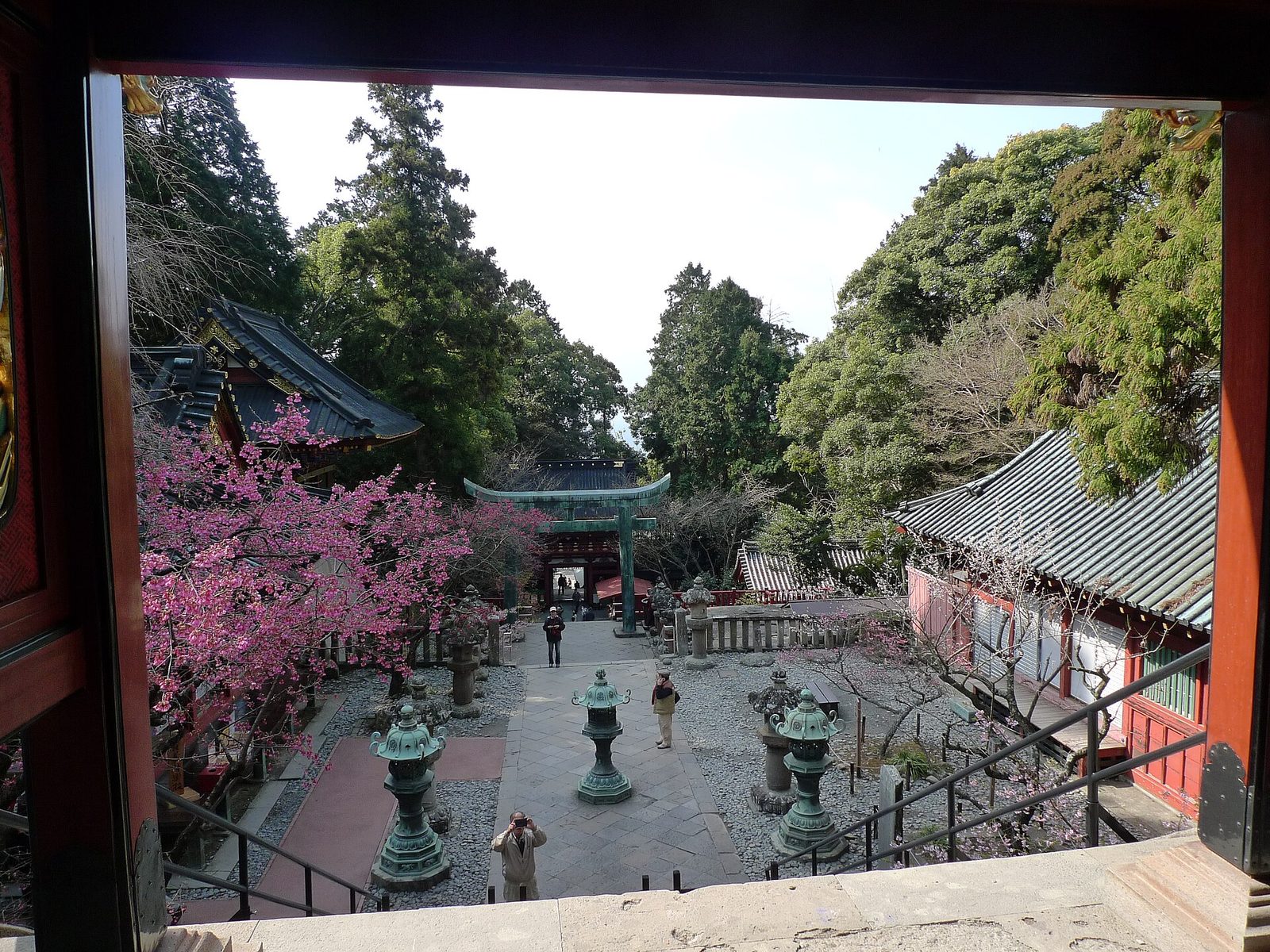
Passing through the shrine gate, you enter a complex of vermilion, black lacquer, and gold leaf clinging to the mountainside — built in a single year by the finest craftsmen of the early Edo period, and the prototype for the more famous Nikko Toshogu that followed.
What to look for:
- The Sanctuary (National Treasure). The main hall’s carvings — peonies, Chinese lions, dragons — reward slow looking. This is *gongen-zukuri* architecture at its origin point.
- Ieyasu’s tomb (Shinbyo). A quiet stone pagoda further up the mountain path, facing west toward his birthplace. Far fewer visitors make it up here; those who do get the most atmospheric spot in the complex.
- The museum. Houses armor and personal effects of Ieyasu, including European-made clocks gifted by the King of Spain — evidence of the international Japan that existed before the country closed its doors. The ¥1,200 combo ticket (shrine + museum) is worth it for history-minded visitors.
| Item | Details |
|---|---|
| Shrine admission | Adults ¥700, children ¥300 |
| Shrine + museum combo | Adults ¥1,200, children ¥500 |
| Hours | 9:00–17:00 (last entry 16:00), open every day |
| Time needed | 60–90 minutes including the museum |
Accessibility note: the shrine itself involves stone stairs beyond the ropeway station. Visitors with limited mobility can still enjoy Nihondaira and the Yume Terrace, which are step-free from the parking area.
Strawberries, Tea, and Other Bonuses
- Ishigaki strawberries (roughly January–May). The sun-baked stone-wall greenhouses along the coast at the foot of Mt. Kuno are the birthplace of Japan’s *ishigaki* strawberry cultivation. In season, farms along the Ichigo Kaigan (“Strawberry Coast”) road offer all-you-can-eat picking — a wonderful add-on if you descend the 1,159 steps.
- Green tea. The slopes around Nihondaira are working tea country. Facilities near the summit offer tea tastings, and in picking season some let you try harvesting leaves yourself. At minimum, have a properly brewed cup at the Yume Terrace café — Shizuoka grows more tea than any other prefecture in Japan.
- Photograph your own ship. From the plateau you can usually spot your cruise ship at Hinode Pier — one of the few places in the world where you can frame your ship and Mt. Fuji in a single photo.
Quick FAQ
Is 5 hours in port enough? Yes, if you taxi both ways and skip the museum. With 4 hours or less, choose between this trip and Miho no Matsubara rather than attempting both.
Can I combine it with Miho no Matsubara? With 7+ hours ashore and a chartered taxi, yes — the classic loop is port → Nihondaira → Kunozan → Miho → port. This is essentially what the $149 excursions do; a 4-hour charter does it for a fraction per person.
What if it’s raining? The ropeway runs in light rain, and the shrine’s carvings arguably look richer wet. But the Nihondaira panorama is the point of the trip — in genuinely poor weather, spend your day at the fish market and S-Pulse Dream Plaza near the port instead.
Do I need cash? The shrine and ropeway counters accept cash for certain; card acceptance is improving but not guaranteed. Bring ¥3,000–5,000 per person in cash to be safe. There is a Seven Bank ATM (international cards OK) at the 7-Eleven near the port — details in our Shimizu Port Complete Guide.
The Bottom Line
Nihondaira and Kunozan Toshogu deliver the two things cruise passengers most hope for from a Japan port call — a postcard Mt. Fuji panorama and genuine, National Treasure-grade history — within 30 minutes of the pier, for a few thousand yen, with no tour booking required. If the weather forecast is clear on your Shimizu day, this is where to spend your morning.
Planning the rest of your day? Start with our Shimizu Cruise Port Complete Guide, and don’t leave without trying the tuna — the Shimizu Seafood Guide tells you exactly where to go.
Have a wonderful voyage.