Miho no Matsubara is a seven-kilometer grove of black pines on Suruga Bay, and part of the UNESCO World Heritage listing for Mount Fuji. On a clear day the snow-capped cone rises directly across the water behind the pines, exactly as it appears in centuries-old woodblock prints — which is precisely why the grove was inscribed, despite standing some 45 kilometers from the mountain. It is also the setting of the Hagoromo celestial-robe legend, and an easy half-day trip from the Shimizu cruise pier. This guide explains what the site is, how to get there, and — the honest part most guides skip — when you can actually expect to see Mount Fuji.
🇯🇵 日本語版はこちら: 日本語で読む
Why Miho no Matsubara Is a UNESCO World Heritage Site
Most visitors are surprised to learn that Miho no Matsubara is not a World Heritage site in its own right — it’s part of something larger.
In June 2013, UNESCO inscribed “Fujisan, sacred place and source of artistic inspiration” on the World Heritage List. This isn’t just the mountain itself; it’s a collection of 25 component sites that together tell the story of how Mount Fuji shaped Japanese religion, culture, and art. Miho no Matsubara is one of those 25 components — and it’s the most distant, sitting roughly 45 kilometers from the mountain.
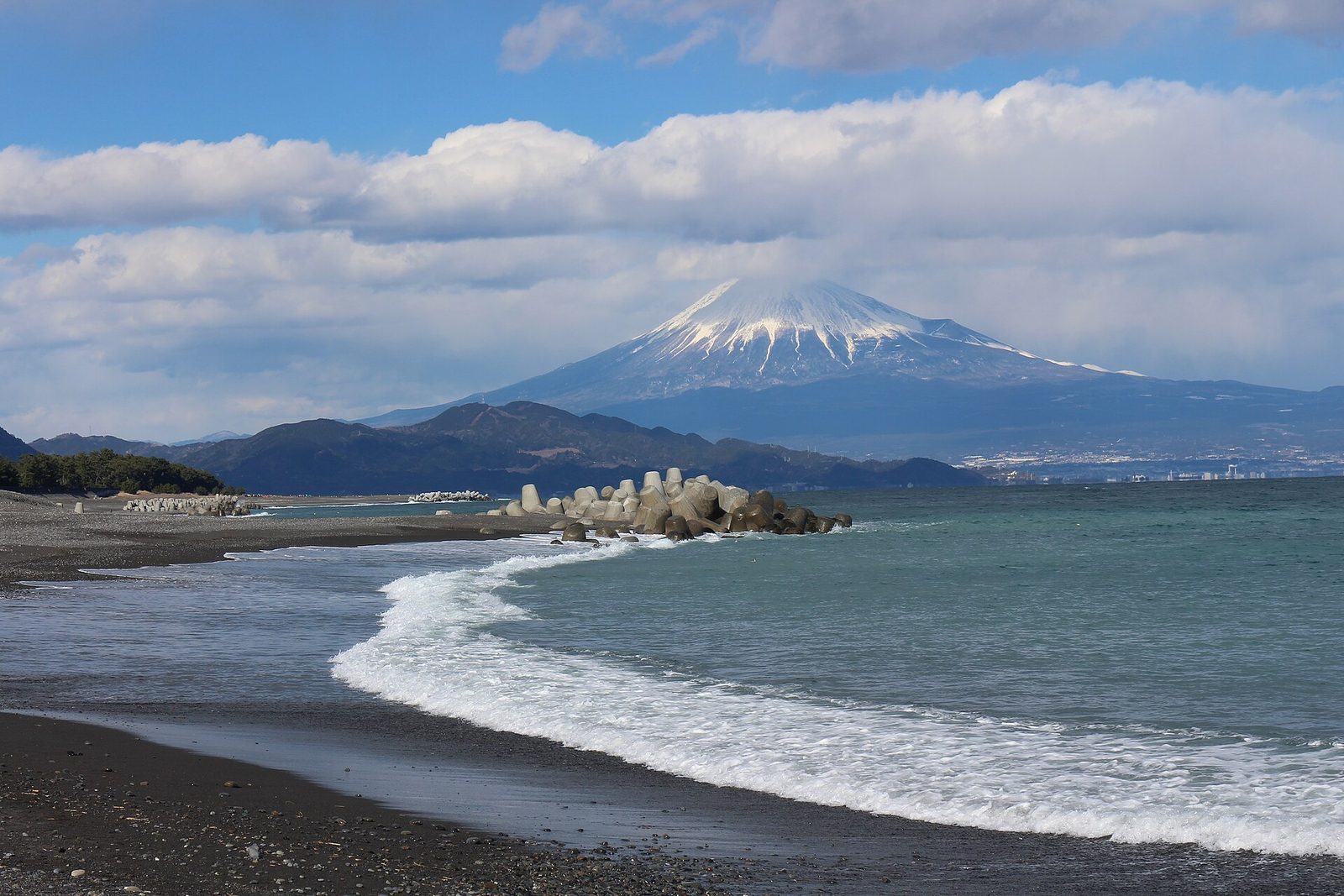
That distance is the whole point. Miho no Matsubara was included not because it’s close to Fuji, but because it’s one of the classic vantage points *from which Fuji was seen, painted, and mythologized.* The view of the snow-capped cone floating above a foreground of black pines and the blue arc of Suruga Bay is the image that inspired generations of Japanese artists, including the ukiyo-e masters whose prints carried Fuji’s shape around the world. When you stand on the beach here, you’re standing inside a picture that predates photography by centuries.
The grove itself is substantial: roughly 30,000 pine trees stretching about seven kilometers along the coastline. Some of the trees are several hundred years old.
The Legend of the Celestial Robe (Hagoromo)
Miho no Matsubara isn’t only a viewpoint — it’s the setting of one of Japan’s most enduring folktales, and understanding it changes how you see the place.
The story goes like this. A fisherman named Hakuryō came ashore one morning and found a beautiful feathered robe — a *hagoromo* — hanging on the branch of a pine tree. As he took it, a heavenly maiden (a *tennyo*) appeared and begged for its return: without the robe, she could not fly back to the heavens. Hakuryō agreed, but only if she would dance for him first. She did — a celestial dance so beautiful it was said to bring blessings to the land — and then rose into the sky and vanished toward Mount Fuji.
This legend became the basis of the classic Noh play “Hagoromo,” still performed today, and it’s why a particular old pine here is known as the Hagoromo Pine (*Hagoromo no Matsu*). The tale gives the grove its atmosphere: this is a place the Japanese have regarded as a bridge between the earthly and the divine for well over a thousand years.
What to See at Miho no Matsubara
The site is compact enough to explore on foot in an hour or two. Here’s what to prioritize.
The Beach and the Mt. Fuji View
This is the reason to come. Walk through the pines to the pebbly shoreline, and — weather permitting — Mount Fuji stands directly across Suruga Bay. The combination of dark pine, pale beach, blue water, and the white cone behind is the definitive Miho no Matsubara image. Morning generally offers the clearest air and the best odds of an unobstructed view.
The Hagoromo Pine (Hagoromo no Matsu)
The tree associated with the celestial-robe legend is marked and easy to find along the main path. Nearby you’ll also find a monument to Hélène Giuglaris, a French dancer who devoted years to the *Hagoromo* story — a small reminder of how far this local legend has traveled.
Kami no Michi — The Path of the Gods
Connecting Miho Shrine (Mihō-jinja) to the coast is a straight, atmospheric avenue lined with tall old pines known as Kami no Michi, “the path of the gods.” By tradition, the deity travels this route to the sea. It’s a quiet, shaded walk of a few hundred meters and a lovely way to approach the grove rather than heading straight for the beach.
Mihoshirube (Visitor Center)
The Miho no Matsubara Culture and Creativity Center, known as *Mihoshirube*, opened in 2019 near the entrance. It’s free to enter and offers well-designed exhibits on the grove, the Fuji connection, and the conservation of the pines, with English-language support. It’s a good first stop for context and for checking current conditions — and a useful shelter if the weather turns.
How to Get to Miho no Matsubara from Your Ship
Your ship docks at Hinode Pier (日の出埠頭). Miho sits on a peninsula across the harbor. There’s no single “best” way to get there — it depends on your budget and how much time you have.
By Taxi — Fastest and Simplest


A taxi from the pier reaches the Miho no Matsubara entrance in roughly 15 to 20 minutes, costing around ¥2,500 to ¥3,500 one way. For a group of three or four, this is the most efficient option: no timetables, door-to-entrance service, and easy to arrange at the pier or at the tourist information desk. Ask the driver for “Miho no Matsubara” (三保松原). Keep the return in mind — have the information desk or a restaurant call a taxi back, as they don’t always wait at the grove.
By Bus — Budget-Friendly
Shizutetsu Just Line buses run from the Shimizu Station area toward Miho. Take a bus bound for Miho and get off at Miho-no-Matsubara Iriguchi (三保松原入口); the ride is roughly 25 minutes and costs around ¥370 to ¥480. From the bus stop, it’s a 15-to-20-minute walk through the neighborhood and pines to reach the shore. This is the cheapest option but the slowest, and it requires comfort with reading bus stops — allow extra buffer if you choose it.
By Water Bus — The Scenic Option


A harbor water bus operates across Shimizu Port and is a pleasant, photogenic way to cross the bay with views back toward the waterfront and, on clear days, Mount Fuji. Routes and schedules change seasonally, so confirm the current timetable and destination at the pier information desk before relying on it — and note that a walk is still required from the landing to the grove itself.
A note on time: Whichever way you go, budget realistically. A taxi round trip plus an hour at the grove fits comfortably in about three hours ashore. The bus option realistically needs four or more.
When Can You Actually See Mount Fuji?
Here’s the honest part that most guides skip: Mount Fuji is frequently invisible. The mountain generates its own clouds, and summer haze often hides it completely. Coming all the way to Miho and seeing only cloud is a real possibility, so set your expectations by season.
| Season | Mt. Fuji Visibility |
|---|---|
| Winter (December–February) | Best of the year. Cold, dry, clear air means frequent, crisp views of a snow-capped Fuji — especially in the early morning. If your port day is in winter, your odds are excellent. |
| Spring (March–May) | Mixed. Clear mornings can be beautiful, but haze increases as the season warms. Morning is far better than afternoon. |
| Summer (June–August) | Poorest. Humidity and haze hide Fuji on most days; it may appear briefly at dawn and then vanish. Come for the grove and the legend, and treat a Fuji sighting as a bonus. |
| Autumn (September–November) | Very good. As the air dries out, clear days return. Late autumn mornings rival winter for visibility. |
The single best tip: go in the morning. Regardless of season, Fuji is most likely to be visible early, before the day’s clouds build.
Combining Miho with the Rest of Your Shimizu Day
Miho no Matsubara pairs naturally with Shimizu’s other great strength — its food. The port is Japan’s largest tuna-landing port, and the fish market and sushi restaurants near the pier are excellent. A common and comfortable plan is to visit Miho in the morning (best light and Fuji odds), then return to the pier area for a seafood lunch before re-boarding.
For exactly what to eat and where, see our companion guide: Shimizu Seafood Guide: What to Eat at Japan’s #1 Tuna Port.
Practical Tips for Cruise Passengers
Go in the morning. It’s worth repeating: your best chance of seeing Mount Fuji, and the calmest light for photos, is early in your port day.
Carry cash. As with the rest of Shimizu, smaller shops and the return taxi may be cash-only. There are convenience-store ATMs (7-Bank ATMs inside 7-Eleven accept international cards) near the station and pier — draw cash before you head out to the peninsula.
Wear comfortable shoes. The approach involves walking on sand, pebbles, and pine-root paths. Flat, closed shoes are much better than sandals here.
Plan your return carefully. Miho is across the harbor from your ship, not a five-minute walk like the market. Build in a comfortable buffer — allow at least 30 to 40 minutes for the return journey plus pier security. Missing your ship’s departure in Japan means arranging onward travel to the next port at your own expense.
Manage expectations about Fuji. The grove, the legend, and the pine-and-sea scenery are worth the trip even when the mountain is hidden. If Fuji is your only reason for coming and the sky is completely socked in, ask at the pier information desk about current visibility before committing the taxi fare.
There’s little food at the grove itself. Aside from a few small shops near the entrance, dining options are limited. Plan to eat back near the pier.
FAQ
Q: Is Miho no Matsubara worth visiting if Mount Fuji isn’t visible?
Yes, though it depends on what you’re after. Even without the mountain, you get a historic UNESCO-listed pine grove, the atmospheric Path of the Gods, the setting of the Hagoromo legend, and a broad beach on Suruga Bay. Many visitors enjoy it as a peaceful, culturally rich walk. But if a guaranteed Fuji photo is your sole goal, check visibility before you go.
Q: How long do I need at Miho no Matsubara?
About one to one and a half hours at the grove itself is enough to walk the Path of the Gods, reach the beach and Hagoromo Pine, and visit the Mihoshirube center. Add round-trip travel time from the pier — roughly 40 minutes by taxi — and you’re looking at a comfortable half-day excursion of around three hours.
Q: Can I get there without speaking Japanese?
Easily by taxi — just say “Miho no Matsubara.” The Mihoshirube visitor center offers English support. The bus is doable with a translation app to confirm the stop (Miho-no-Matsubara Iriguchi), but taxis remove the guesswork.
Q: Is it accessible for older travelers or those with limited mobility?
The main paths are flat, but the final approach to the water is over sand and pebbles, which some find difficult. The Path of the Gods and the visitor center are easy; the beach itself requires steadier footing.
*Last updated: July 2026. Bus routes, water-bus schedules, and taxi fares are subject to change — confirm current details at the Shimizu pier tourist information desk. Mount Fuji visibility is never guaranteed; morning and the winter months offer the best odds.*